
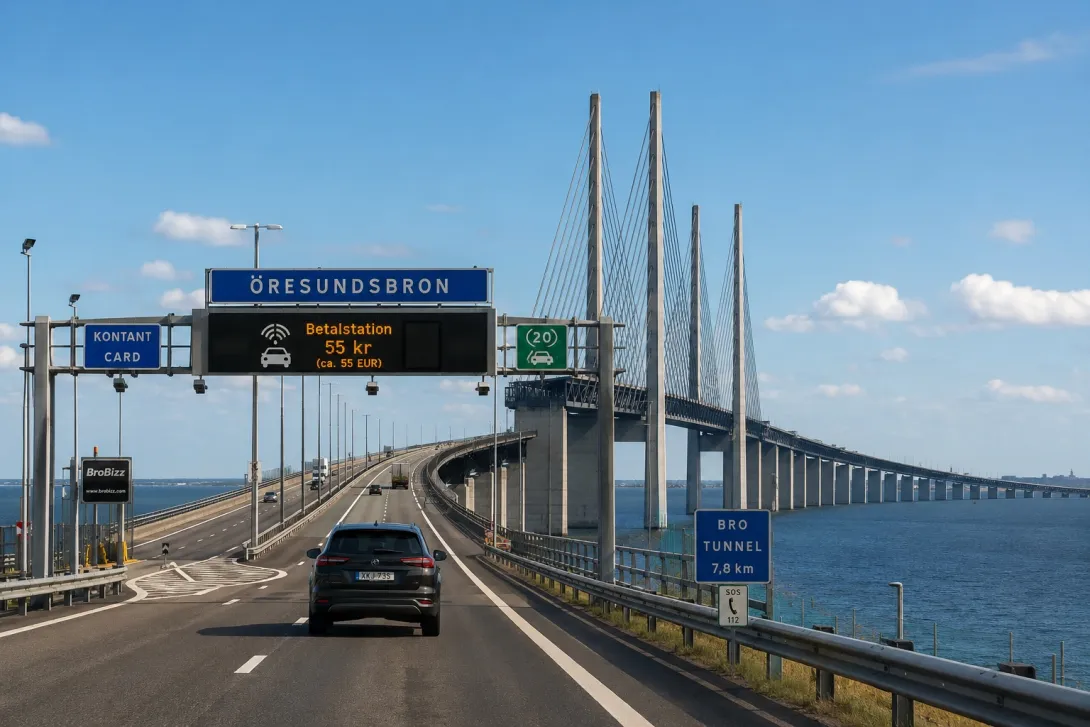
The Oresund Bridge: Engineering That Connects Continents
The Malmo to Verona route begins with a 7.8-kilometer engineering achievement: the Oresund Bridge. Completed in 2000, this combined rail and road bridge-tunnel system crosses the Oresund Strait, linking Sweden to Denmark. Your journey starts by paying the toll (approximately 55 EUR for a standard car) and driving across this structure, which transitions into the Drogden Tunnel midway.
This initial crossing sets the tone for a trip that traverses multiple European regions, from Scandinavian flatlands to Alpine passes and into the Po Valley. The total driving distance is roughly 1,650 kilometers if you follow the most direct highway route via the E4, E20, E45, and A22. While some might question whether such a long drive is worthwhile, the variety of landscapes, urban centers, and cultural shifts you experience make this an exceptional overland adventure. For those wondering how long to drive Malmo to Verona, expect about 16-17 hours of pure driving time without stops, spread across multiple days for a comfortable pace.
Route Planning and Practical Details
| Segment | Highways | Distance | Driving Time | Key Notes |
|---|---|---|---|---|
| Malmo to Copenhagen | E20 via Oresund Bridge | ~35 km | 40 min | Toll bridge, border crossing (Schengen) |
| Copenhagen to Hamburg | E47/E45 via ferry or E20 via Great Belt Bridge | ~350 km | 4 hours | Consider Puttgarden-Rodby ferry (45 min) or bridge route |
| Hamburg to Frankfurt | A7, A5 | ~500 km | 5 hours | German autobahns, some sections without speed limits |
| Frankfurt to Munich | A3, A9 | ~390 km | 4 hours | Passes near Nuremberg |
| Munich to Verona | A95, A8, A22 via Brenner Pass | ~375 km | 4.5 hours | Alpine crossing, check winter tire requirements |
Essential preparations include ensuring your vehicle documentation is valid for all countries (Sweden, Denmark, Germany, Austria, Italy), carrying a reflective vest and warning triangle, and having winter tires if traveling between November and April, especially for the Brenner Pass section. The Brenner Pass, at 1,370 meters elevation, is a critical point on the A22 highway connecting Austria to Italy; it's open year-round but can have snow restrictions.
Toll systems vary: Denmark's bridges have fixed tolls, Germany's autobahns are generally free for cars, Austria requires a vignette (10-day pass ~9 EUR), and Italy uses both vignettes (for highways like A22) and telepass systems. Fuel costs will be highest in Germany and Italy, more moderate in Denmark and Sweden. For finding interesting places to pause beyond standard rest areas, our article on how to find the best stops and hidden gems between cities offers practical methods.
Recommended Places to Pause and Explore
Choosing the best stops Malmo to Verona depends on your interests, but several locations offer distinct experiences. Copenhagen, immediately after crossing the Oresund Bridge, deserves at least a few hours. Visit the Vor Frelsers Kirke for its external spiral staircase offering city views, or walk through the Christiania freetown.
Driving south, the Medieval Center in Nykobing Falster (Denmark) reconstructs a 1390s market town with hands-on activities. Hamburg's Speicherstadt, the world's largest warehouse district, features brick Gothic architecture and the Miniatur Wunderland model railway.
Near Frankfurt, the Rhine Valley between Rudesheim and Koblenz presents castle-dotted hillsides; consider a short river cruise. Nuremberg's Documentation Center at the Nazi Party Rally Grounds provides a sobering look at 20th-century history. Munich's Englischer Garten, larger than Central Park, has a river surf spot at the Eisbach wave. Innsbruck, just before the Brenner Pass, combines Alpine scenery with Habsburg-era architecture like the Goldenes Dachl. Bolzano, in Italy's South Tyrol, houses the Otzi the Iceman museum.
Each stop breaks the drive into manageable segments while adding depth to the journey. For more ideas on things to do between Malmo and Verona, research local festivals or seasonal markets along your travel dates.
A Three-Day Driving Schedule
This Malmo to Verona itinerary 3 days balances driving with exploration.
Day 1
Depart Malmo early, cross the Oresund Bridge, and spend late morning in Copenhagen. Drive south via the E47, taking the Puttgarden-Rodby ferry (reservations recommended in summer). Continue to Hamburg (approx. 4.5 hours total driving). Overnight in Hamburg, exploring the port area or St. Pauli district.
Day 2
Drive from Hamburg to Munich via the A7 and A9 (about 6 hours with brief rest stops). Pause in Nuremberg for lunch and a quick visit to the Hauptmarkt square. Arrive in Munich by late afternoon; overnight there, perhaps visiting a beer hall like Hofbrauhaus.
Day 3
The final leg from Munich to Verona takes about 4.5 hours via the A8 and A22 through the Brenner Pass. Stop in Innsbruck for a midday break to see the Hofkirche court church. Descend into Italy, and consider a pause in Bolzano to see the South Tyrol Museum of Archaeology. Arrive in Verona by evening, where you can view the Roman Arena lit at night. This schedule assumes 6-8 hours of driving daily with 3-4 hours for stops. Adjust based on weather, especially mountain conditions. Is it worth driving Malmo to Verona on this timeline? Yes, if you appreciate seeing the landscape transition from Scandinavian bridges to German forests to Alpine peaks within a few days.
Continue Your Adventure
- Antwerp to Rotterdam Road Trip: The Industrial & Delta Route
- Bergen Wroclaw Road Trip Guide Route Stops 3 Day Itinerary Road Trip Guide
- Munich to Salzburg Road Trip: 5 Best Stops & Scenic Alpine Route
- Malmo Rome Road Trip Guide Routes Stops 3 Day Itinerary Road Trip Guide
- Malmo Paris Road Trip 3 Day Itinerary Best Stops Road Trip Guide
Frequently Asked Questions
What is the total driving distance and time from Malmo to Verona?
The most direct highway route covers approximately 1,650 kilometers. Pure driving time, without stops, is about 16-17 hours, but with breaks and traffic, plan for 20+ hours spread over multiple days.
Are there any mountain passes or difficult driving sections?
Yes, the Brenner Pass on the A22 highway between Austria and Italy reaches 1,370 meters elevation. It's well-maintained but can have snow, fog, or traffic delays. Winter tires are legally required in certain conditions (typically November-April). The Alpine approaches also have tunnels and curves requiring attention.
What documents do I need for this cross-border road trip?
Ensure you have a valid driver's license, vehicle registration, and proof of insurance (a Green Card is recommended). All countries en route are in the Schengen Area, so passport checks are minimal, but carry ID. Austria requires a vignette (toll sticker) for its motorways; Italy uses a mix of vignettes and electronic tolls.
Can this trip be done year-round?
Yes, but winter (December-February) brings challenges: shorter daylight, potential snow on the Brenner Pass, and colder temperatures. Summer offers longer days but more traffic, especially on German autobahns and Alpine routes. Spring and autumn provide a balance of mild weather and fewer crowds.
What are some alternative stops if I have extra time?
With additional days, consider detours to Lubeck's brick Gothic old town, Rothenburg ob der Tauber's medieval walls, the Neuschwanstein Castle near Fussen, or Lake Garda before Verona. Each adds 1-2 hours of driving but expands the cultural and scenic variety.