
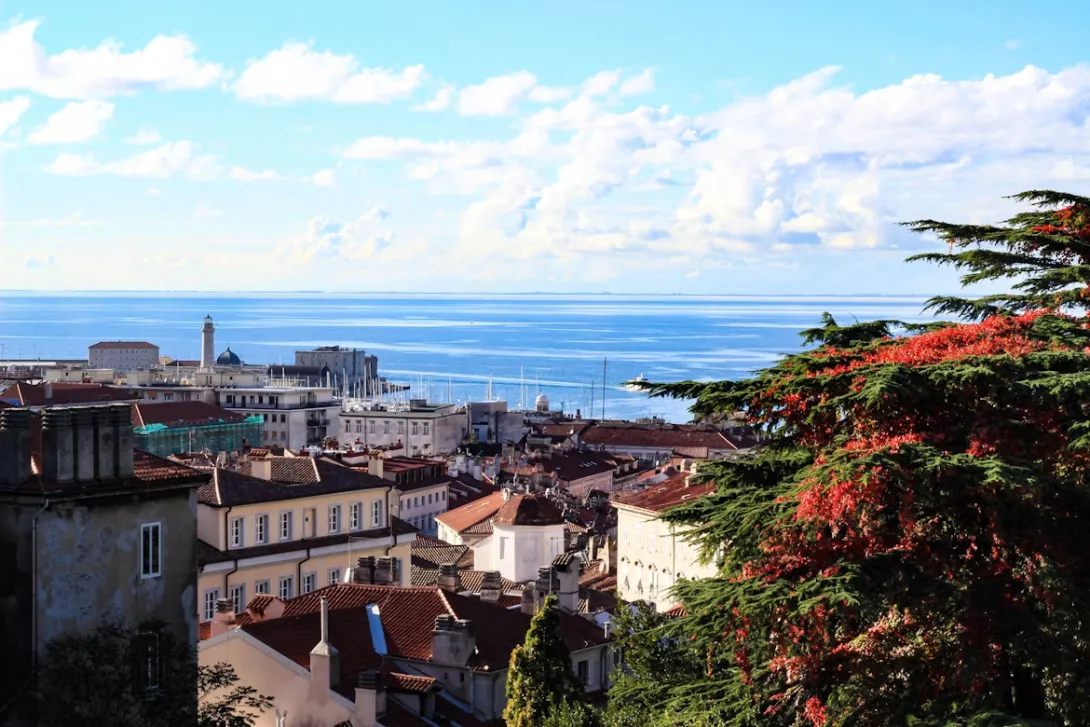
Introduction: The Istrian Coastal Drive
Departing Trieste via the A1/E61 highway toward Slovenia, you'll cross the border at Pesek/Kozina—a crossing notorious for sudden Queues during summer weekends. The 130-kilometer route to Pula typically takes 90 minutes without traffic, but the Istrian coastal road (D66/E751) demands slower speeds due to curves and coastal views.
The Istrian peninsula is a geological mosaic: flysch cliffs near Trieste give way to karst limestone plateaus south of Buzet, then to mediterranean maquis and red soil (terra rossa) toward Pula. The Bora wind—a katabatic wind from the northeast—can gust suddenly along exposed sections, especially between Opatija and Rijeka.
| Segment | Distance | Time | Road |
|---|---|---|---|
| Trieste to Rijeka | 75 km | 50 min | A1/E61, A7/E61 |
| Rijeka to Opatija | 14 km | 15 min | D66 |
| Opatija to Pula | 92 km | 1 h 20 min | D66/E751 |
Road Safety, Family Stops, and Fatigue Management
Road quality is good on the A1 and D66, but the D66 is two-lane with sharp turns near Mošćenička Draga. Night driving: sections through the Učka tunnel are well-lit; outside, street lighting is minimal after 23:00. Safety tips: watch for bicycles on the D66 near Lovran, and always use low beams in fog patches near Čičarija.
- Child-friendly stop: the Aquapark Istralandia (near Brtonigla) features slides and pools; open June–September. Or visit the Adventure Park Opatija for zip-lining.
- Pet-friendly: the beach at Moscenicka Draga allows dogs (leashed) year-round; the cafe 'Barka' in Rovinj has water bowls and shade.
Fatigue management: the rest area 'Rijeka - Kikovica' (km 20 of the D66) has shaded parking and a small kiosk. For a power nap, the 'Bivak' off A1 at exit 18 (near Jurdani) offers 4-hour free parking and WC. If you need to stretch, take the exit for 'Lovran' and walk the Lungomare promenade (12 km coastal path).
- Hidden off-route spot: the abandoned military fort 'Fort Napoleon' near the village of Vrh (5 min from D66) offers a panoramic view of Kvarner Bay.
- Culinary infrastructure: try 'Konoba Batelina' in the small port of Banjole for grilled fish, and roadside stand 'Školjka' near Fažana for fresh oysters.
Route Logistics and Infrastructure
Fuel prices in Croatia are generally 5-10% lower than Italy. For the Trieste-Pula drive, plan for 10-12 liters of fuel (€15-18) in a compact car. Topography is hilly between Buzet and Pazin, so fuel efficiency drops to 7-8 L/100km; maintain steady speeds.
- Fuel stations: plentiful along A1 (every 25 km) but sparse on D66 after Opatija. Fill up in Trieste or Rijeka.
- Tolls: Croatian highways require electronic toll collection (ENC) or cash at booths. Total toll Trieste-Rijeka is ~€6.
- Border crossing: EU border at Pesek/Kozina, usually open 24h. Have passports ready.
Unique local quirk: near the village of Koper, you'll find a road sign for 'Hrvatini' that, due to a typo, once read 'Hrvatmi'—a collector's item among road enthusiasts. Also, the D66 through the Učka tunnel (length 5,300 m) may have strong crosswinds; check wind warnings.
Natural Landscapes and Local Commerce
The route passes the Učka mountain massif (peak 1,396 m) and then descends toward the Adriatic. South of Opatija, the coastline features limestone cliffs, pebble beaches (like Ičići), and dense forests of Aleppo pine and holm oak. The dramatic shift from alpine to Mediterranean occurs within 20 minutes of driving south of Rijeka.
- Geographical highlights: the Lim Bay (a flooded karst valley) near Vrsar, and the Brijuni archipelago (visible from the D75 side road).
- Sunset spot: pull over at the viewpoint near the village of Sveti Ivan (45.179°N, 13.711°E) between 18:00 and 19:30 for a perfect Adriatic sunset.
No UNESCO World Heritage sites lie directly on the route, but the Euphrasian Basilica in Poreč (UNESCO, 1997) is an hour west of Pula’s center. Near Trieste, the Miramare Castle (not UNESCO) is a 19th-century treasure. For a short detour, the town of Motovun (25 min off the D66 near Buzet) offers a medieval hilltop village.
- Local crafts: stop at roadside stalls near Pazin for hand-painted ceramic plates and truffle-infused oils.
- Authentic produce: buy fresh olive oil from the OPG (family farm) stands between Vodnjan and Pula, especially 'Buža' olive grove.
Continue Your Adventure
- Almeria Bergen Road Trip 3500Km European Drive Guide Road Trip Guide
- Almeria Brussels Road Trip Guide Route Stops 3 Day Itinerary Road Trip Guide
- Ljubljana Szeged Road Trip Best Stops Route 3 Day Itinerary Road Trip Guide
- Debrecen Brussels Road Trip Guide Route Stops Itinerary Road Trip Guide
- Ghent Zurich Road Trip Route Stops 3 Day Itinerary Road Trip Guide
Frequently Asked Questions
How long to drive Trieste to Pula?
The direct drive is about 90 minutes without traffic, but plan 2-3 hours to enjoy stops. For the best stops Trieste to Pula, see the route guide above.
Is it worth driving Trieste to Pula?
Yes—especially for the scenic coastal views, historic towns, and hidden gems. Use how to find the best stops and hidden gems between cities.
Things to do between Trieste and Pula?
Visit Opatija's Austro-Hungarian villas, the ancient Roman town of Poreč, and taste local truffles and olive oil. Also explore the Lim Bay fjord.