
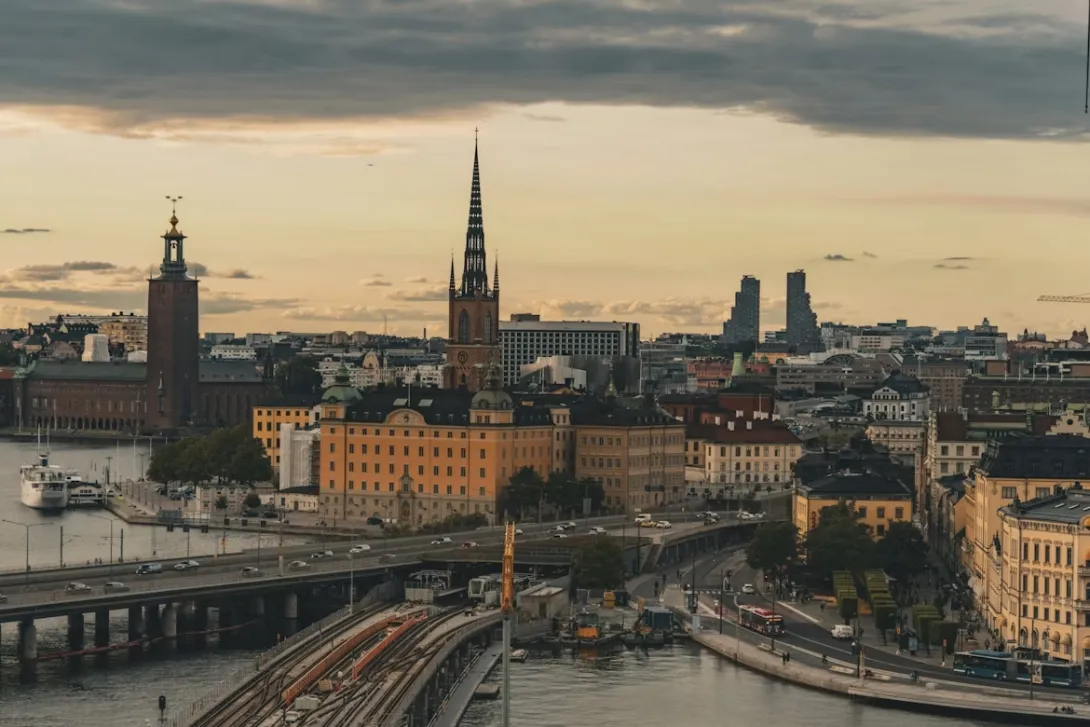
Crossing Europe's Continental Divide
The Stockholm to Rome route spans approximately 2,800 kilometers and crosses the watershed between the Baltic and North Sea drainage basins near the Swedish-Danish border. This geographical transition marks the beginning of a continental journey that moves from Scandinavian granite bedrock to Alpine limestone formations and finally Mediterranean volcanic soils. The primary highway sequence begins with Sweden's E4, which connects to Denmark's E45 via the Øresund Bridge—a 16-kilometer combined road and rail link that opened in 2000 and fundamentally altered travel patterns between Scandinavia and mainland Europe. From there, the route continues through Germany's autobahn network, Austria's Alpine passes, and Italy's autostrada system, presenting drivers with changing road conditions, toll systems, and driving conventions across seven distinct national jurisdictions.
Route Logistics and Practical Details
| Segment | Highway | Distance | Driving Time | Key Features |
|---|---|---|---|---|
| Stockholm to Malmö | E4 | 615 km | 6-7 hours | Swedish toll-free motorway, frequent rest areas |
| Malmö to Hamburg | E45/Øresund Bridge | 340 km | 4-5 hours | Bridge toll (approx. €54), German border crossing |
| Hamburg to Munich | A7/A8 | 775 km | 7-8 hours | German autobahn sections without speed limits |
| Munich to Innsbruck | A8/A93 | 160 km | 2 hours | Alpine crossing, Austrian vignette required |
| Innsbruck to Verona | A13/Brenner Pass | 290 km | 3-4 hours | Mountain pass (1,374m), Italian toll roads begin |
| Verona to Rome | A1 | 620 km | 6 hours | Apennine Mountains, multiple service stations |
The total driving time without stops ranges from 28 to 32 hours, depending on traffic conditions and border formalities. Required documentation includes a valid driver's license, vehicle registration, and proof of insurance with minimum coverage of €1 million. Sweden, Denmark, and Germany use right-hand traffic, as do Austria and Italy, maintaining consistency throughout. Toll systems vary: Sweden has no road tolls (except congestion charges in Stockholm), Denmark charges for the Øresund Bridge, Germany's autobahns are generally free, Austria requires a vignette (€9.90 for 10 days), and Italy uses both vignettes and distance-based tolls on the autostrada. Fuel costs fluctuate significantly along the route, with Sweden typically having the highest prices and Italy offering more competitive rates. For planning specific segments, consider using resources like how to find the best stops and hidden gems between cities to optimize your route based on current conditions and interests.
Three-Day Driving Schedule
A Stockholm to Rome itinerary 3 days requires disciplined driving but allows for meaningful stops.
Day 1: Depart Stockholm at 6:00 AM, drive E4 south to Malmö (6-7 hours). Cross the Øresund Bridge (30 minutes plus toll payment) and continue on E45 to Hamburg (4-5 hours). Overnight in Hamburg, covering approximately 955 kilometers. Day 2: Leave Hamburg by 7:00 AM, take A7 south to Würzburg, then A3 to Nuremberg, and finally A9 to Munich (7-8 hours). After a brief stop, continue on A8/A93 to Innsbruck (2 hours). Overnight in Innsbruck, completing about 935 kilometers.
Day 3: Depart Innsbruck at 6:00 AM, cross Brenner Pass on A13 into Italy (1 hour), then take A22 to Modena, connecting to A1 south to Rome (9-10 hours with traffic). Arrive in Rome by early evening, covering approximately 910 kilometers. This accelerated schedule prioritizes driving efficiency while incorporating overnight stops in major cities. For those with more time, extending to 5-7 days allows for deeper exploration of intermediate locations and reduces daily driving to 4-6 hours.
Strategic Route Breaks and Detours
When considering things to do between Stockholm and Rome, strategic stops can transform a long drive into a memorable continental crossing. Copenhagen, immediately after the Øresund Bridge, offers Nyhavn's 17th-century waterfront and the Round Tower observatory, with parking available at Israels Plads. Hamburg's Speicherstadt district, the world's largest warehouse complex, provides a striking contrast with its red-brick Gothic architecture and accessible parking near Baumwall station. Munich's Englischer Garten, larger than New York's Central Park, features Chinese Tower beer garden and surfers riding the Eisbach river's standing wave—park at Königinstrasse. Innsbruck's Nordkette cable car transports visitors from the city center to 2,256 meters above sea level in 20 minutes, with parking at Hungerburg station. Verona's Roman Arena, still hosting opera performances, stands in Piazza Bra with underground parking nearby. Bologna's Two Towers, Asinelli and Garisenda, lean dramatically over the city center, with parking available at Piazza VIII Agosto. Each of these locations provides distinct cultural and visual markers along the north-south axis of Europe.
Continue Your Adventure
Frequently Asked Questions
How long to drive Stockholm to Rome without stops?
The direct driving time is approximately 28-32 hours, covering about 2,800 kilometers via the E4, E45, German autobahns, and Italian A1. This assumes favorable traffic conditions, efficient border crossings, and adherence to speed limits where applicable.
Is it worth driving Stockholm to Rome versus flying?
Driving offers advantages including flexibility, ability to transport more luggage, and the experience of crossing multiple European landscapes. The financial calculation depends on fuel costs (approximately €350-450), tolls (€100-150), and accommodations versus airfare for multiple people. The driving option becomes more compelling for groups or those planning extended stays along the route.
What are the best stops Stockholm to Rome for overnight breaks?
Recommended overnight locations include Hamburg (after Day 1), Munich or Innsbruck (after Day 2), and Bologna or Florence (if extending beyond 3 days). These cities offer ample accommodation options, secure parking facilities, and dining establishments that accommodate late arrivals from the road.
What documents are required for this international drive?
Essential documents include a valid driver's license (EU format or International Driving Permit for non-EU licenses), vehicle registration certificate, proof of insurance with minimum €1 million coverage, passport or national ID card, and credit card for toll payments. Rental vehicles require specific cross-border authorization documentation.
What seasonal considerations affect this route?
Winter months (November-March) bring potential snow and ice, particularly through Sweden, Denmark, and Alpine passes, requiring winter tires or chains. Summer offers longer daylight but increased tourist traffic and higher accommodation costs. Spring and autumn typically provide balanced conditions with moderate temperatures and fewer road closures.