
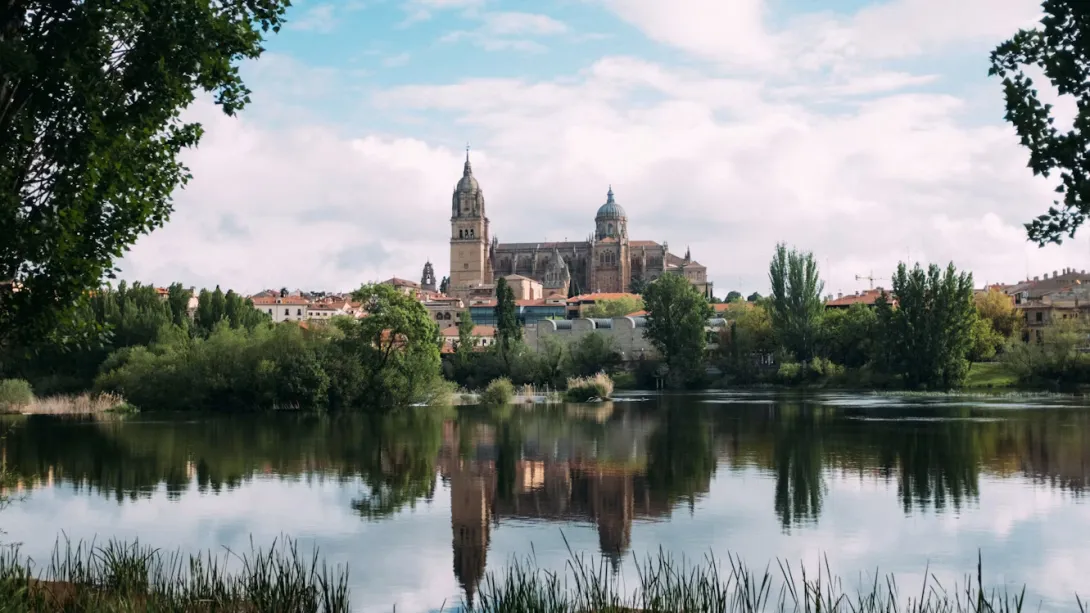
Introduction: The Iberian-French Crossing
This 850-kilometer route from Salamanca to Vannes traverses the Meseta Central, the Basque mountains, the Aquitaine coast, and southern Brittany. The drive takes 9–11 hours without stops, using the A-62, A-63 (E05), A-10, and E60/E50 corridors. The only direct highway crosses the border at Irun/Hendaye, where the Spanish AP-8 meets the French A-63.
A curious fact: near Burgos, you'll pass the exact midpoint of a pilgrimage route that has been used since the 9th century. The Roman road 'Via Aquitania' once linked this territory to the Atlantic.
For context, a typical itinerary involves two full days of driving with overnight stops. For tips on finding hidden gems along the way, see how to find the best stops and hidden gems between cities.
| Segment | Highway | Distance (km) | Time (hours) |
|---|---|---|---|
| Salamanca to Burgos | A-62 | 220 | 2.5 |
| Burgos to Bordeaux | A-63 (E05) | 450 | 4.5 |
| Bordeaux to Vannes | A-10/E50 | 180 | 2 |
Road Safety, Family Stops, and Fatigue Management
Road quality: Spanish A-62 is well-maintained; French A-63 is excellent. Watch for speed cameras (fixed and mobile) in France. Speed limits: 120 km/h (Spain), 130 km/h (France) on highways. Seatbelts mandatory. Toll plazas require full stop.
- Family suitability: Rest areas with playgrounds (Aire de Parempuyre, Aire de l'Adour) and pet-friendly zones. Many hotels along the route accept pets (e.g., Ibis Budget Bayonne).
- Pet-friendly framework: French rest stops often have dog walking areas; keep leash required in Spain.
- Fatigue management: Recommended rest stops every 2 hours – Burgos area (Area de Servicio Los Llanos), near Bayonne (Aire de la Nive), and Saintes (Aire de Saintes).
Hidden off-route spots: The medieval village of Laguardia (Rioja wine region, 30 km detour from A-68 near Logroño) offers bodegas carved into rock. Also, the Côte Sauvage (wild coast) near Quiberon has dramatic cliffs and ancient oyster beds.
Culinary infrastructure: From Burgos' lechazo (roast lamb) to Bayonne's chocolatines, via Bordeaux's canelés, the route is a gastronomic journey. In Vannes, order a kouign-amann and a bowl of moules-frites. Is it worth driving Salamanca to Vannes? Absolutely, for the convergence of landscapes and tastes.
Natural Landscapes and Local Commerce
Departing Salamanca, the landscape is golden plains dotted with holm oaks. Near Burgos, the Sierra de la Demanda rises. Crossing into France, the Basque Country offers green hills and the Atlantic coast. In Aquitaine, vast pine forests of Les Landes dominate before reaching the Gironde estuary.
- Natural highlights: Mirador de la Cuesta (viewpoint on N-1), Dune du Pilat (Europe's tallest sand dune, 2 km detour near Bordeaux), and the Quiberon peninsula near Vannes.
- Local commerce: Burgos' market for chorizo, Bordeaux's Cité du Vin for wine tasting, and Vannes' covered market (Les Halles) for oysters and galettes.
- UNESCO World Heritage Sites: Burgos Cathedral (1984), Bordeaux's Port of the Moon (2007), and Santiago de Compostela's Camino routes passing through Salamanca (buffer zone).
Climatic conditions: Summer (June–Aug) average 25–30°C; winter (Dec–Feb) 5–10°C with rain in Brittany. Fall offers mild temperatures and fewer crowds. Best months: May–June or September–October.
Route Logistics and Infrastructure
Highways in Spain (A-62, AP-1) and France (A-63, A-10) are tolled. Expect tolls from Burgos to Bordeaux costing around €45 (total). Fuel prices: Spain ~€1.60/L, France ~€1.80/L (2025 averages). Diesel is recommended for range.
- Best fuel stops: Area de Servicio La Brújula (km 170 on A-62), Aire de l'Adour (A-63), and Aire de la Charente (A-10).
- Tolls can be paid by card or cash; French toll booths accept contactless.
- Vignettes required? No, but electronic toll passes (like Bip&Go) ease passage.
Route economics: total cost for a round trip (fuel + tolls) ~€200. Using the AP-1 instead of A-1 near Burgos saves 20 minutes but costs €10 extra.
How long to drive Salamanca to Vannes? Minimum 9 hours 30 minutes; with meal and rest stops, 11–12 hours often needed.
Continue Your Adventure
Frequently Asked Questions
How long does it take to drive from Salamanca to Vannes?
The drive takes 9–11 hours without stops, but with rest, meals, and sightseeing, plan for 11–13 hours. Breaking the journey into two days is recommended.
What are the best stops between Salamanca and Vannes?
Top stops include Burgos Cathedral (UNESCO), Bordeaux (Port of the Moon, Cité du Vin), Dune du Pilat, and the medieval town of Quimper (near Vannes). Check the hidden gem Laguardia in Rioja.
Are there good family-friendly rest stops?
Yes, rest areas like Aire de Parempuyre (playground, picnic) and Aire de l'Adour (mini-golf) cater to families. Pet-friendly stops are common in France.
Is the route safe for solo travelers?
The highways are well-lit and patrolled. Petty theft can occur at rest stops; keep valuables out of sight. Overall, it's a safe journey.
Do I need a toll pass?
Not necessary, but a Bip&Go (French) or Via-T (Spanish) electronic device saves time. Cash is accepted at most toll booths.