
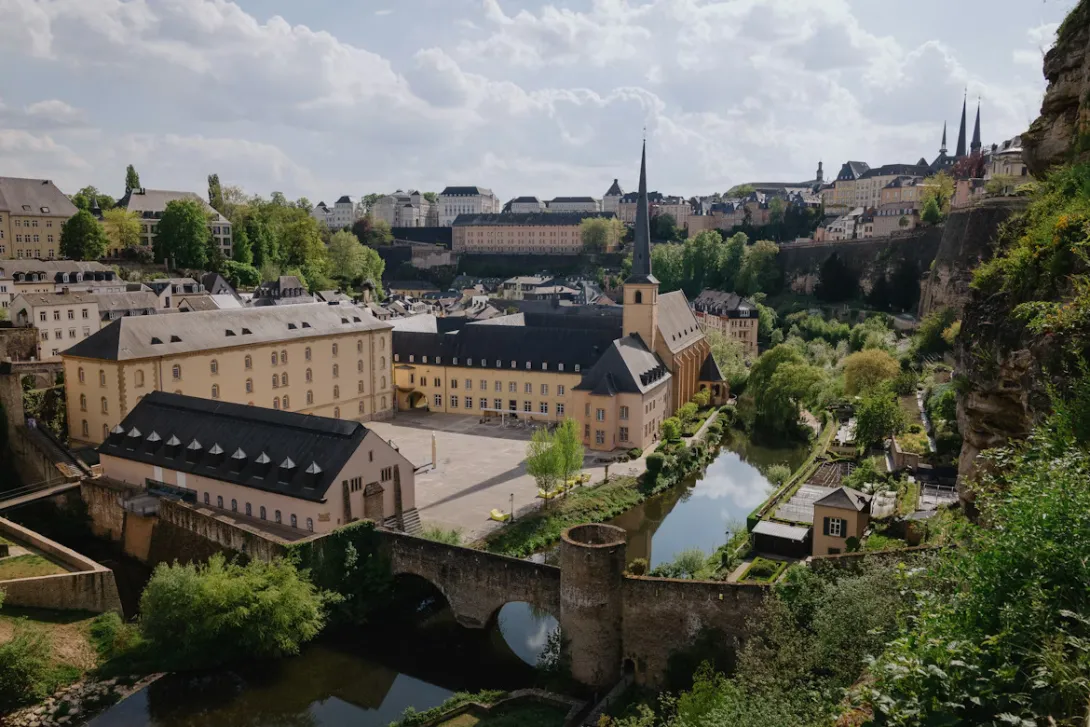
Introduction
The A4 motorway in Luxembourg, completed in 2003, connects the capital to Germany's A64, forming the initial segment of this 350-kilometer drive to Utrecht. This route crosses three national borders within its first 100 kilometers, passing through Luxembourg's Moselle valley, Germany's Eifel region, and the Dutch province of Limburg before reaching the Randstad. The journey involves navigating Luxembourg's complex tunnel system beneath the city, Germany's unrestricted autobahn sections near Trier, and the Netherlands' managed motorway network with its dynamic speed limits. Road surfaces change noticeably at each border crossing, from Luxembourg's recently resurfaced concrete to Germany's older asphalt and the Netherlands' noise-reducing porous asphalt. This drive offers a practical study in European infrastructure differences while connecting two financial centers with distinct urban characters.
Route Logistics and Practical Information
| Segment | Highways | Distance | Driving Time | Notes |
|---|---|---|---|---|
| Luxembourg City to German Border | A4, A64 | 40 km | 35 minutes | Tunnel de la Pétrusse toll-free, speed cameras active |
| Germany to Dutch Border | A64, A61, A40 | 180 km | 2 hours | Unrestricted sections on A61 near Trier, roadworks common on A40 |
| Netherlands to Utrecht | A73, A2 | 130 km | 1 hour 25 minutes | Variable speed limits (100-130 km/h), congestion around Eindhoven |
| Total Route | A4-A64-A61-A40-A73-A2 | 350 km | 4 hours minimum | Border checks rare, vignette not required, fuel cheaper in Luxembourg |
Direct driving time without stops typically ranges from 4 to 5 hours depending on traffic conditions, particularly around Luxembourg City during morning rush hour (7:30-9:00) and on the A2 approaching Utrecht in late afternoon. The Netherlands enforces a 100 km/h daytime speed limit on most motorways, while Germany maintains unrestricted sections where conditions allow. For planning intermediate pauses, consider our guide on how to find the best stops and hidden gems between cities which provides systematic approaches to route planning. Luxembourg requires winter tires from November to March, while the Netherlands mandates dipped headlights during daytime in poor visibility. Toll collection is electronic in Luxembourg (Viapass) but not required for passenger vehicles on this route.
Recommended Intermediate Locations
For those wondering about things to do between Luxembourg and Utrecht, several locations merit consideration. Trier, Germany, approximately 45 minutes from Luxembourg City via the A64, contains eight UNESCO World Heritage sites including the Porta Nigra Roman gate and the Imperial Baths. The city center parking at Viehmarktplatz costs €2 per hour with a 3-hour maximum. Maastricht, Netherlands, accessible via the A2 after crossing from Germany, features the 13th-century Basilica of Saint Servatius and the modern Bonnefanten Museum of art. Parking at the Sphinxkwartier underground facility costs €3.50 per hour. Valkenburg aan de Geul, 20 minutes from Maastricht, offers thermal baths at Thermae 2000 and underground tours of the Velvet Cave, with combined tickets available for €28. 's-Hertogenbosch, directly on the A2 about 45 minutes before Utrecht, contains the Gothic St. John's Cathedral with its 96-meter tower and the Jheronimus Bosch Art Center dedicated to the local painter. Each location provides distinct architectural and cultural elements without requiring substantial detours from the primary route.
A Three-Day Travel Plan
This Luxembourg to Utrecht itinerary 3 days allows thorough exploration while maintaining reasonable daily driving distances.
Day 1: Depart Luxembourg City at 9:00, drive 45 minutes to Trier via the A64. Visit the Roman amphitheater (€4 admission) and the Electoral Palace gardens. Lunch at Zum Domstein restaurant near the cathedral. Drive 1.5 hours to Cochem on the Moselle River, check into Hotel Burgfrieden. Evening visit to Reichsburg Castle (last entry 17:00).
Day 2: Depart Cochem at 8:30, drive 1 hour to Maria Laach Abbey via the A48. Tour the 11th-century basilica and volcanic lake. Continue 1.5 hours to Maastricht via the A61 and A2. Lunch at Café Zondag in the historic district. Afternoon at the Bonnefanten Museum (€14). Overnight at Hotel Derlon.
Day 3: Depart Maastricht at 9:00, drive 30 minutes to Valkenburg. Morning at Thermae 2000 thermal baths. Drive 1.5 hours to 's-Hertogenbosch via the A2. Lunch at Korte Putstraat cafes. Afternoon cathedral visit and Jheronimus Bosch Center (€12). Final 45-minute drive to Utrecht, arriving approximately 17:00. This schedule maintains driving segments under 2 hours while incorporating architectural, historical, and natural elements from each region traversed.
Continue Your Adventure
Frequently Asked Questions
How long to drive Luxembourg to Utrecht?
The direct drive covers 350 kilometers via the A4, A64, A61, A40, A73, and A2 highways. Without stops, driving time typically ranges from 4 to 5 hours depending on traffic conditions, particularly around Luxembourg City (morning rush hour 7:30-9:00) and on the A2 approaching Utrecht in late afternoon. Border crossings rarely add significant time as there are no routine checks between these Schengen countries.
Is it worth driving Luxembourg to Utrecht?
Driving offers advantages over rail or air alternatives for this route. The road journey allows access to intermediate locations like Trier's Roman sites and Maastricht's medieval center that aren't easily reached by direct train connections. Cost comparison shows fuel expenses of approximately €45-€55 for a standard vehicle versus train fares starting at €65 per person with limited luggage. Driving also provides schedule flexibility, though parking in Utrecht averages €4.50 per hour in the city center versus train station parking at €2.50 per hour.
What are the best stops Luxembourg to Utrecht?
Primary intermediate locations include Trier, Germany (45 minutes from Luxembourg) with its UNESCO Roman monuments; Cochem on the Moselle River (1.5 hours further) featuring Reichsburg Castle; Maastricht, Netherlands (2.5 hours from Luxembourg) with its medieval architecture and museums; and 's-Hertogenbosch (45 minutes before Utrecht) containing Gothic cathedral architecture. Each requires minimal detour from the A64-A61-A2 corridor and offers distinct historical periods from Roman to medieval to modern.