
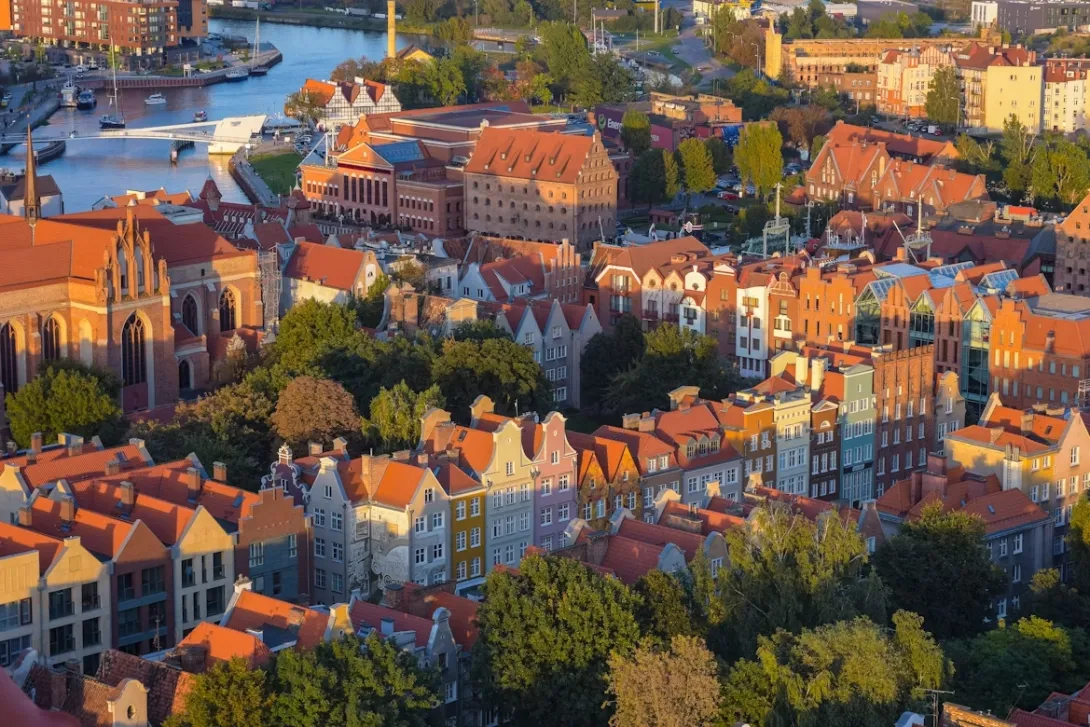
The Amber Route Connection
This 540-kilometer route from Gdansk to Berlin follows parts of the historic Amber Road, a trading network that connected the Baltic Sea to the Mediterranean for over two thousand years. Polish drivers on the A1 highway often use their hazard lights briefly to thank other drivers who let them merge—a local custom unfamiliar to many international travelers. The drive crosses three distinct regions: Poland's Pomeranian Voivodeship, the lake districts of northern Poland, and Germany's Brandenburg state, with terrain shifting from coastal plains to forested hills. For those planning this journey, understanding the practical aspects of this specific corridor is essential. The question of whether this drive is worth undertaking depends on your interest in seeing the transition between Baltic and Central European landscapes, experiencing border crossings that have transformed since EU expansion, and visiting towns that played significant roles in Hanseatic League trade networks. This guide provides concrete details to help you decide.
Route Details and Practical Information
| Segment | Highway/Road | Distance | Driving Time | Notes |
|---|---|---|---|---|
| Gdansk to Toruń | A1/E75 | 165 km | 2 hours | Toll section ends near Grudziądz |
| Toruń to Poznań | A1 then S5/E261 | 155 km | 1 hour 45 min | Watch for construction near Gniezno |
| Poznań to Świebodzin | S3/E65 | 105 km | 1 hour 15 min | Passes through Zielona Góra region |
| Świebodzin to Berlin | A2/E30 | 115 km | 1 hour 30 min | German autobahn section begins at border |
The total driving time without stops is approximately 6.5 hours, but most travelers will want to allocate a full day for the direct journey or 2-3 days with exploration. The A1 highway in Poland has variable speed limits (140 km/h on some sections, 100 km/h in construction zones), while the German A2 typically has recommended speeds of 130 km/h. Fuel costs average €85-€100 for the entire trip in a standard car. Border formalities are minimal since both countries are in the Schengen Area, but you should carry your passport or EU ID card. For those wondering how long to drive Gdansk to Berlin without interruptions, early morning departures can complete the journey in under 7 hours, though afternoon traffic around Poznań and approaching Berlin can add 30-60 minutes.
A Three-Day Travel Plan
Day 1: Depart Gdansk by 9 AM via the A1, reaching Toruń around 11 AM. Visit the Copernicus House at Kopernika 15/17 (€4 admission) and the Leaning Tower at Pod Krzywą Wieżą 1. Drive 90 minutes to Poznań, checking into accommodation near the Old Town. Evening meal at a milk bar (bar mleczny) for traditional Polish fare.
Day 2: Morning at Poznań's Cathedral Island, then drive 75 minutes to Zielona Góra for lunch at a local winery—this region produces Polish wine despite northern latitudes. Continue 45 minutes to Świebodzin to see the Christ statue. Overnight in Słubice or cross into Germany for Frankfurt (Oder).
Day 3: Final 90-minute drive to Berlin via the A12, arriving by noon. This Gdansk to Berlin itinerary 3 days allows for substantial exploration while maintaining reasonable driving segments of 2-3 hours daily. Alternative routes could include detouring to Gniezno on Day 1 to see the 10th-century cathedral or extending Day 2 to visit the Tropical Islands resort near Krausnick, but these additions would require adjusting timing.
Recommended Places to Visit Along the Way
Toruń, 165 kilometers from Gdansk, merits at least two hours for its intact medieval layout and the Museum of Gingerbread at Rabiańska 9, where you can participate in baking workshops. The city's astronomical clock at St. Mary's Church dates to the 15th century. Continuing southwest, Poznań's Old Market Square features mechanical goats that butt heads daily at noon from the Town Hall clock tower—a spectacle that draws consistent crowds. The Imperial Castle at Św. Marcin 80/82 offers panoramic views. For those interested in how to find the best stops and hidden gems between cities, consider Świebodzin's Christ the King statue, which at 36 meters tall is visible from the highway. The statue's construction between 2001-2010 involved local fundraising efforts. Nearby, the Muskau Arch geopark straddles the German-Polish border and offers walking trails through post-mining landscapes. When considering things to do between Gdansk and Berlin, these locations provide structured breaks from driving while offering distinct regional characteristics.
Continue Your Adventure
Frequently Asked Questions
What is the best time of year to drive from Gdansk to Berlin?
Late spring (May-June) and early autumn (September) offer mild weather with fewer tourists. July-August brings higher traffic and accommodation prices. Winter driving requires preparation for potential snow, especially on Polish sections of the A1.
Are there tolls on this route?
Yes, Poland's A1 highway has electronic tolls for vehicles over 3.5 tons. Passenger cars typically use the viaTOLL system with on-board units available at border stations. The German sections have no tolls for cars. Total cost for cars is approximately €10-€15.
What documents do I need for border crossing?
Since both Poland and Germany are in the Schengen Area, there are no routine passport checks. However, you must carry a valid passport or EU national ID card. Rental cars require the vehicle registration and insurance documents (usually provided by the rental company).
Where are good overnight stops between Gdansk and Berlin?
Poznań offers the most accommodation options mid-route. Toruń works for shorter first-day drives. For splitting the trip evenly, consider Zielona Góra or Frankfurt (Oder) near the border. Book ahead in summer months.
Is the road quality good on this route?
The Polish A1 and S5 highways are modern and well-maintained, though occasional construction occurs. German autobahns (A2, A12) have excellent surfaces. Secondary roads in both countries are generally good, but some rural Polish roads may have narrower lanes.