
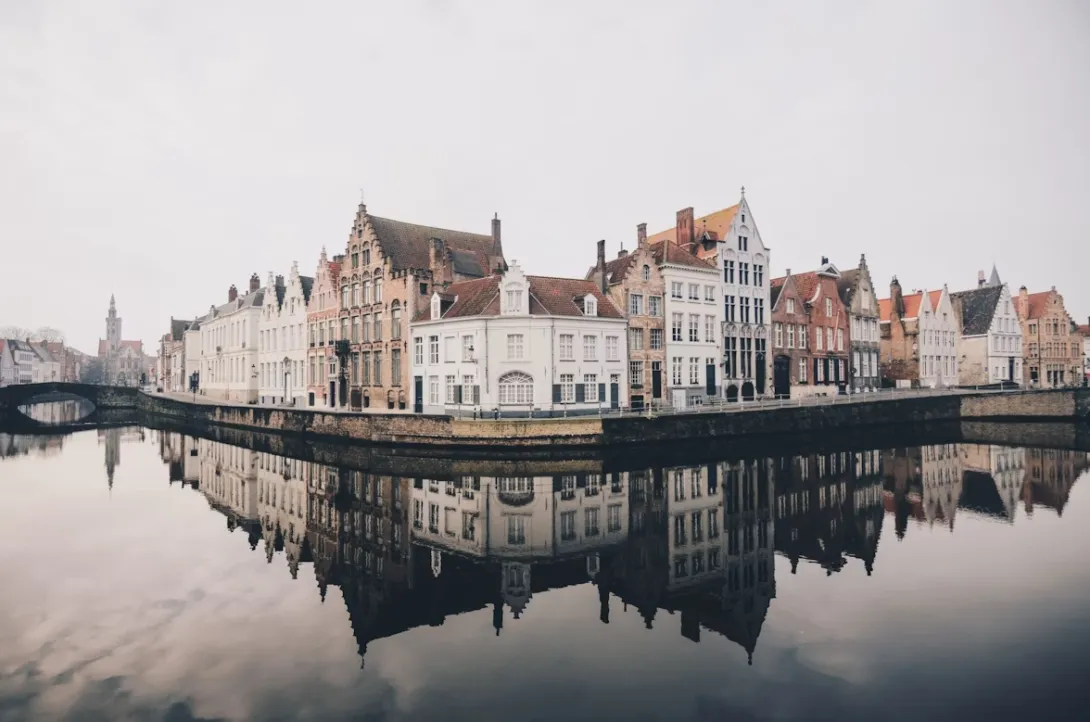
Introduction
The E40 highway connecting Bruges to Bordeaux follows a path that Roman engineers established nearly two millennia ago, originally linking the North Sea ports to the wine regions of Aquitaine. Today's drivers cover 900 kilometers across three distinct national borders, transitioning from Belgium's flat canal-crossed landscapes to France's rolling Loire Valley and finally to the Atlantic coastal plains. This route requires navigating Belgium's complex ring roads around Brussels, France's extensive toll system on the A10, and the gradual shift from Flemish to French to Occitan linguistic regions. The journey represents one of Western Europe's most complete cross-sections, moving from medieval trading centers to Renaissance châteaux to vineyard-covered hillsides, with driving conditions that change significantly as you progress southward.
Three-Day Travel Plan
Day 1: Bruges to Tours (310 km, 3.5 hours driving)
Depart Bruges early via the E403, crossing into France near Lille. Consider a brief stop in Arras to see its Flemish-style squares before continuing on the A1. Arrive in Tours by mid-afternoon, allowing time to visit the cathedral and walk along the Loire River banks. Overnight in Tours, where hotels cluster near the station and city center.
Day 2: Tours Region Exploration (Minimal driving)
Dedicate this day to Loire Valley châteaux without the A10 tolls. Villandry opens at 9:00 AM, with its gardens most striking in morning light. Continue to Azay-le-Rideau, a Renaissance château surrounded by water, then return to Tours via the D751. Evening could include dinner in Tours' historic district, perhaps trying rillettes (potted pork) paired with local Vouvray wine.
Day 3: Tours to Bordeaux (340 km, 3.5 hours driving)
An early start puts you in Saint-Émilion by late morning. Park at the visitor lot and explore the underground church and cloisters. Continue to Bordeaux, arriving with sufficient daylight to view the Place de la Bourse and its water mirror. The quays along the Garonne River provide walking paths with views of the 18th-century architecture. This Bruges to Bordeaux itinerary 3 days balances driving with exploration, though adding a fourth day would allow more thorough visits.
This schedule assumes good weather and light traffic. French school holidays in February, April, and July increase congestion, particularly on the A10 south of Poitiers. Tolls can be paid with credit cards at automated stations, though some booths accept cash. Accommodations in Tours and Bordeaux should be booked in advance during summer months. The route offers numerous alternatives, including coastal detours via La Rochelle or inland routes through the Dordogne, but the A10 provides the most efficient connection between these endpoints.
Route Logistics and Practical Details
| Segment | Route | Distance | Driving Time | Key Features |
|---|---|---|---|---|
| Bruges to Lille | E403 to A27 | 75 km | 1 hour | Belgian ring roads, border crossing near Tournai |
| Lille to Paris Region | A1 to A16 | 215 km | 2.5 hours | French tolls begin, bypass Amiens via A29 |
| Paris Region to Tours | A10 | 235 km | 2.5 hours | Major toll section, Loire Valley approach |
| Tours to Bordeaux | A10 continuation | 340 km | 3.5 hours | Longest uninterrupted stretch, Cognac region passage |
| Total Route | E40/A10 primary | 900 km | 9-10 hours | Requires €60-80 in French tolls |
The direct Bruges to Bordeaux drive takes approximately nine to ten hours without stops, though most travelers will want to break this into multiple days. French autoroutes require toll payments, with the A10 section from Paris to Bordeaux costing approximately €45. Belgium's E40 has no tolls but features frequent speed camera enforcement. Diesel averages €1.65 per liter in France, slightly less than Belgium's €1.70. Border formalities between Belgium and France are minimal since both are Schengen Area countries, but you'll notice immediate changes in road signage and driving styles. French drivers tend to use the left lane more aggressively for passing only, while Belgian roads have more complex intersections. Planning rest stops is essential, as service areas on the A10 can be 30-40 kilometers apart in some sections. For those wondering how long to drive Bruges to Bordeaux without interruptions, it's a full day's journey best approached with scheduled breaks.
Recommended Route Stops and Activities
Lille makes a logical first pause 75 kilometers from Bruges, with its 17th-century Vauban citadel and the Palais des Beaux-Arts housing works by Rubens and Goya. The city's Flemish architecture contrasts with the French atmosphere, visible in the Old Stock Exchange building's courtyard. Continuing south, the A1 passes near Amiens, where the 13th-century cathedral—the largest in France by volume—dominates the skyline. The Hortillonnages floating gardens, accessible by flat-bottomed boats, offer a unique perspective on the region's agricultural history.
As you approach the Loire Valley via the A10, Tours serves as an excellent base for exploring châteaux. Villandry, 15 kilometers west, maintains Renaissance gardens arranged in geometric patterns, while Chenonceau spans the Cher River with its distinctive gallery. The city center of Tours itself features half-timbered houses on Rue Colbert and the Saint-Gatien cathedral with its flamboyant Gothic facade.
Poitiers, approximately halfway between Bruges and Bordeaux, provides another break opportunity. The Futuroscope theme park focuses on multimedia and technology exhibits, while the city's historical center contains the Baptistère Saint-Jean, one of France's oldest Christian buildings dating from the 4th century. The Romanesque church of Notre-Dame-la-Grande has a sculpted facade depicting biblical scenes.
Approaching Bordeaux, the landscape shifts to vineyards around Saint-Émilion, 35 kilometers east of the city. The monolithic church carved from limestone and the underground catacombs demonstrate medieval engineering. The town's steep, cobbled streets require parking outside the walls. For those considering things to do between Bruges and Bordeaux, these stops represent the route's geographical and cultural progression. Finding worthwhile pauses requires research; our article on how to find the best stops and hidden gems between cities offers additional strategies for route planning.
Continue Your Adventure
Frequently Asked Questions
What is the driving distance and time from Bruges to Bordeaux?
The direct route covers approximately 900 kilometers via the E40 and A10 highways. Without stops, driving time ranges from 9 to 10 hours, depending on traffic conditions and border crossings. This assumes compliance with speed limits (130 km/h on French autoroutes, 120 km/h in Belgium) and accounts for toll plaza delays.
Should I drive from Bruges to Bordeaux or take alternative transport?
Driving offers flexibility to visit intermediate locations like Lille, the Loire Valley châteaux, and Saint-Émilion that train travel doesn't easily accommodate. However, the French toll system adds €60-80 to costs, and parking in historic centers can be challenging. High-speed trains connect the cities in about 5 hours but require advance booking and limit luggage. For travelers wanting to control their schedule and access rural areas, driving proves worthwhile despite the toll expenses.
What are the essential items to prepare for this road trip?
Required documents include a valid driver's license, vehicle registration, and insurance green card. France mandates breathalyzers (though penalties are not enforced), warning triangles, and high-visibility vests for all occupants. A toll transponder (Liber-t in France) simplifies payment, though credit cards work at most plazas. Navigation should account for areas with limited cellular service, particularly in rural sections between Poitiers and Bordeaux.
When is the optimal time to undertake this journey?
Late spring (May-June) and early autumn (September-October) provide mild temperatures and fewer tourists. Summer offers long daylight hours but brings higher accommodation costs and crowded attractions. Winter months see reduced hours at many châteaux and potential fog in the Loire Valley. The Bordeaux wine harvest in September creates lively local activity but requires earlier hotel reservations.
Are there particular driving regulations I should know?
France prohibits radar detectors and requires headlight adjustment for right-hand drive vehicles. Speed limits reduce to 110 km/h in rain and 50 km/h in fog. Belgium uses priority-from-the-right rules at unmarked intersections. Both countries have strict blood alcohol limits (0.05%). French autoroutes have emergency phones every 2 kilometers, marked with blue signs bearing a telephone symbol.