
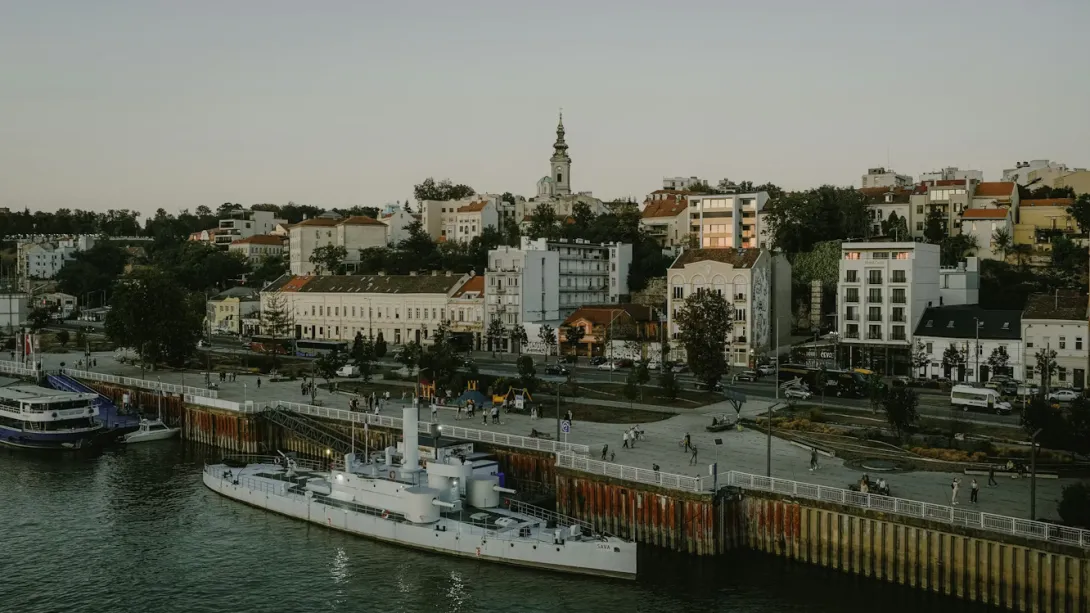
The Belgrade-Munich Corridor: A Historical Passage
This route follows ancient trade paths used by Roman legions moving between the Danube and Alpine regions. Modern drivers on the E75 highway near Belgrade pass through the same Morava Valley corridor that facilitated medieval salt and amber transport. The road from Belgrade to Munich crosses three distinct climatic zones: the Pannonian Basin's continental plains, the Dinaric Alps' karst landscapes, and the Alpine foothills' temperate forests. Local driving quirks include Serbia's frequent use of roundabouts in newer intersections and Austria's requirement for winter tires from November to April on certain mountain passes. The total distance is approximately 900 kilometers, with driving times varying significantly based on border crossings and seasonal conditions.
Essential Places to Visit Along the Route
Novi Sad, 80 kilometers north of Belgrade, offers Petrovaradin Fortress with its clock tower whose minute hand is shorter than its hour hand. The fortress tunnels extend 16 kilometers. Budapest provides thermal baths like Széchenyi, fed by artesian springs at 74°C. The Chain Bridge, completed in 1849, was the first permanent connection between Buda and Pest. Vienna's Schönbrunn Palace has 1,441 rooms, with the Hall of Mirrors where six-year-old Mozart performed for Empress Maria Theresa. The Naschmarkt has operated since the 16th century. Salzburg's Hohensalzburg Fortress, built in 1077, is Central Europe's largest fully preserved castle. The Getreidegasse shopping street maintains wrought-iron guild signs from medieval times. Between Salzburg and Munich, Chiemsee lake contains Herrenchiemsee Palace, Ludwig II's unfinished replica of Versailles with a 98-meter Hall of Mirrors. Practical stops include Erdberg bus station in Vienna for clean facilities and Serbian rest areas along E75 that often sell local ajvar and kajmak.
A Three-Day Driving Schedule
Day 1: Belgrade to Budapest (330 km, 4-5 hours driving)
Depart Belgrade early via E75. Stop at Sremski Karlovci, 12 kilometers from Novi Sad, for Bermet wine at the 19th-century wine cellars. Continue to Subotica for lunch at Boss Cafe with local fish paprikash. Cross into Hungary at Horgoš-Röszke border (allow 30-60 minutes). Arrive Budapest by mid-afternoon. Visit the Hungarian Parliament building (advance tickets required) or take the Funicular to Buda Castle. Overnight in District V or XIII.
Day 2: Budapest to Salzburg (540 km, 6-7 hours driving)
Morning at Széchenyi Baths (opens 6 AM). Drive west on M1/E60 toward Vienna. Stop at Győr's Baroque downtown for coffee at Múzeum Cafe. Continue to Vienna, parking at Park & Ride Erdberg. Visit the Austrian National Library's State Hall (housed 200,000 volumes when opened in 1726). Drive A1 west to Salzburg, arriving by evening. Walk the Getreidegasse before dinner at St. Peter Stiftskulinarium (established 803 CE).
Day 3: Salzburg to Munich (150 km, 2 hours driving)
Morning at Hohensalzburg Fortress via funicular. Drive A8 toward Munich, stopping at Chiemsee for a 45-minute ferry to Herrenchiemsee Palace (first ferry 9 AM). Continue to Munich, parking at P+R Fröttmaning. Visit the Deutsches Museum (world's largest science museum) or English Garden's Chinese Tower beer garden. This schedule balances driving with specific attractions, though adjusting based on personal interests and using resources like how to find the best stops and hidden gems between cities can optimize your experience.
Route Logistics and Practical Details
| Segment | Highway/Road | Distance | Driving Time | Border Crossings |
|---|---|---|---|---|
| Belgrade to Novi Sad | E75/A1 | 80 km | 1 hour | None |
| Novi Sad to Subotica | E75 | 150 km | 2 hours | None |
| Subotica to Budapest | E75/M5 | 180 km | 2.5 hours | Horgoš-Röszke |
| Budapest to Vienna | M1/E60 | 240 km | 2.5-3 hours | None (both EU) |
| Vienna to Salzburg | A1/E55 | 300 km | 3 hours | None |
| Salzburg to Munich | A8/E52 | 150 km | 1.5-2 hours | None |
Total driving time without stops ranges from 10-12 hours. The most efficient route follows E75 north from Belgrade to Budapest, then E60 west to Vienna, continuing on A1/E55 to Salzburg, and finally A8/E52 to Munich. Toll systems vary: Serbia uses vignettes purchased at gas stations, Hungary requires an e-vignette online, Austria has both vignettes for cars and GO-Box for certain vehicles, while Germany has no vignette but charges trucks. Fuel costs average 15-20% higher in Austria than Serbia. For planning assistance, consider how to find the best stops and hidden gems between cities as a resource for route customization.
Continue Your Adventure
Frequently Asked Questions
How long does it take to drive from Belgrade to Munich?
Direct driving time without stops is approximately 10-12 hours covering 900 kilometers. With typical breaks and border crossings, plan for 12-14 hours. The route passes through Serbia, Hungary, Austria, and Germany, with potential delays at the Serbia-Hungary border (Horgoš-Röszke) of 30-90 minutes depending on time of day and season.
What are the best stops between Belgrade and Munich?
Key stops include Novi Sad's Petrovaradin Fortress, Budapest's thermal baths and Parliament, Vienna's Schönbrunn Palace and Naschmarkt, Salzburg's Hohensalzburg Fortress, and Chiemsee's Herrenchiemsee Palace. Smaller worthwhile stops are Sremski Karlovci for wine tasting, Győr's Baroque center, and Austrian rest areas with local produce.
Is driving from Belgrade to Munich worth it compared to flying?
Driving offers advantages including cost savings for groups (fuel and tolls total approximately €150-200 vs. flights from €100-300 per person), flexibility to visit multiple destinations, and ability to transport more luggage. Disadvantages include longer travel time (12+ hours vs. 1.5-hour flight plus airport time) and potential border delays. The drive is particularly worthwhile if you want to visit intermediate cities or have specific items to transport.
What should I know about border crossings on this route?
The Serbia-Hungary border at Horgoš-Röszke requires passport checks for non-EU citizens (Serbia isn't in Schengen). Hungary, Austria, and Germany have no border controls within the Schengen Area. Have vehicle documents, insurance green card, and passports ready. Border wait times average 30-60 minutes but can exceed 2 hours during summer weekends. Check current conditions via border wait time websites.
What are the road conditions like on this route?
Highways are generally well-maintained: Serbia's A1/E75 has some older sections with occasional potholes near Belgrade. Hungarian M5 and Austrian A1 are modern with frequent service areas. German A8 has ongoing construction near Munich. Winter conditions affect Austrian alpine sections (A1 near Salzburg) where snow chains may be required from November to March. Speed limits vary: Serbia 130 km/h, Hungary 130 km/h, Austria 130 km/h (with variable limits), Germany often unlimited but with recommended 130 km/h.